

Much has been said about the United Kingdom leaving the European Union. “We will bring sovereignty back to our borders!” and “This is the beginning of the end for the EU!”. The press constantly talks about the economic effects of this momentous decision, ending 40 years of Britain’s close relationship with the European mainland. So you might wonder, why did the British people choose to join it in the first place?
What is forgotten so often is that Britain didn’t just want to join the EU 40 years ago, it needed to join; and it wasn’t some governmental decision that brought the UK in, the British public voted for it.
The British Psyche
The British social consciousness has always kept itself distant from mainland Europe, both because of the geography of the country and the power the country used to have. From commonwealth to empire, British power and influence once spanned a third of the globe, and a quarter of the world’s population. Therefore, other powers such as France and Germany were seen as rivals; ones which Britain wanted as little association as possible. Even Winston Churchill once said “We are with Europe, but not of it”.
Globalisation vs. Empire
However, the economy was telling a different story. Although the EU officially became an entity in 1993 with the Maastricht Treaty, it de-facto existed since 1950, with the European Coal and Steel Community. In the years since, as Europe became tighter, Britain was beginning to fall rapidly behind. Most Britons thought they could rely on their empire, but the rapid decolonisation of India, the Middle East and Africa left them isolated. A decade later, the difference in overall GDP between the EU and UK was 13%.
“No matter” the people of Britain must have said. “We will survive”. The UK government continued to ridicule and downplay the early communities of Europe, of course angering the major powers of France and West Germany. However, the economic disparity between the UK and the EU kept growing, and the UK economy was, for lack of a better world, flailing.
A Complicated Relationship
Exasperated, Prime Minister Harold MacMillan finally decided that he would approach joining the EU. However, like a bitter ex-girlfriend, French President Charles De Gaulle, who was already mistrustful of those he referred to as “Anglo Saxons” vetoed the UK’s membership in 1963.
What happened next was an almost complete collapse of the UK economy, and UK society began a rapid decline as well. Strikes, unemployment, poverty, all rose at a dramatic rate. The capital, London, was becoming so bad that the population was declining, something unimaginable today.
The UK would have to wait almost a decade, until Charles De Gaulle resigned from the presidency in 1969, in order to join the European community. In 1973, under Prime Minster Edward Heath, the UK finally joined the European Economic Community. There is a reason why I say EEC and not EU – Britain never fully joined the EU as an entity. It kept its currency, the pound, and kept the option to “opt-out” if the EU decided to move closer to a single federal state.
Brexit in 1975?
Yes, it nearly happened. In 1974 Labour (of all parties) decided that they would force the government to hold a referendum on renegotiating Britain’s relationship with the EEC, much like Brexit today. A year later, two – thirds of the British population voted to stay in.
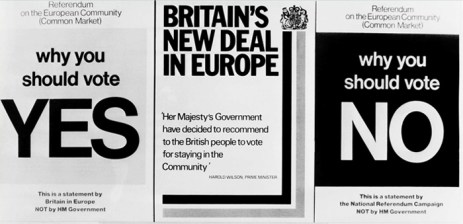
At that time, the British public suffered enough economic woes to know that they needed Europe, even with all the questions about “sovereignty” that still exist to this day. Will they need to suffer in the same way to come to a similar conclusion after Brexit? Only time will tell.
 Historyan
0 comments on “UK + EU = It’s Complicated”